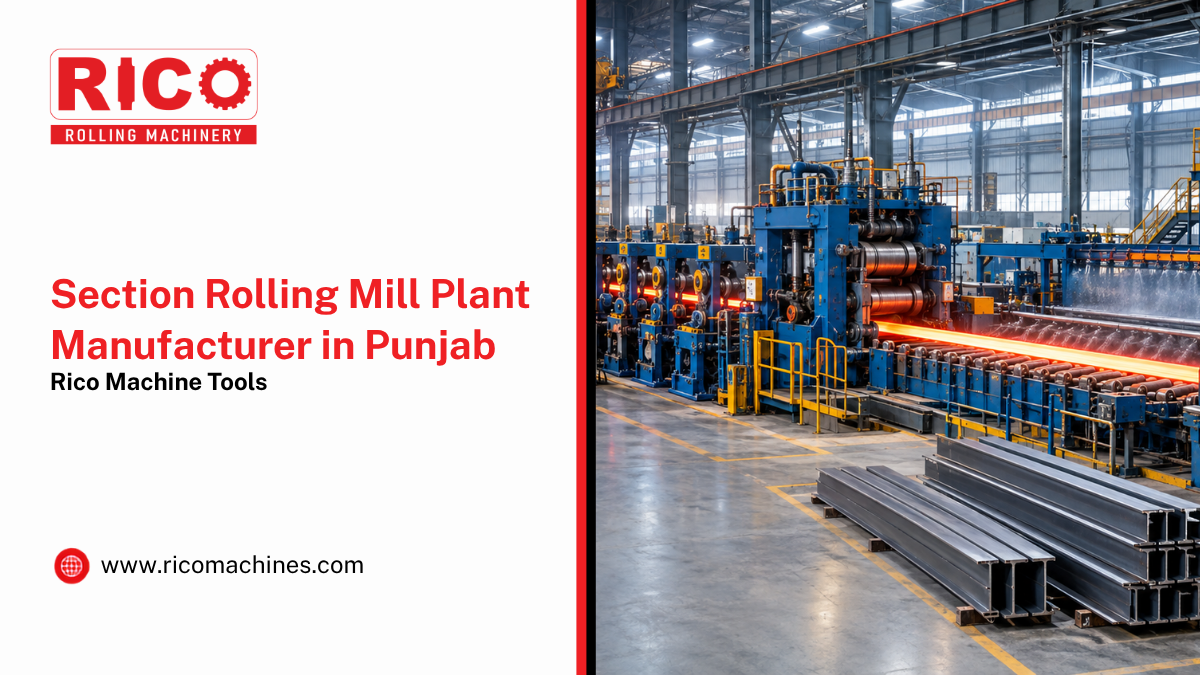
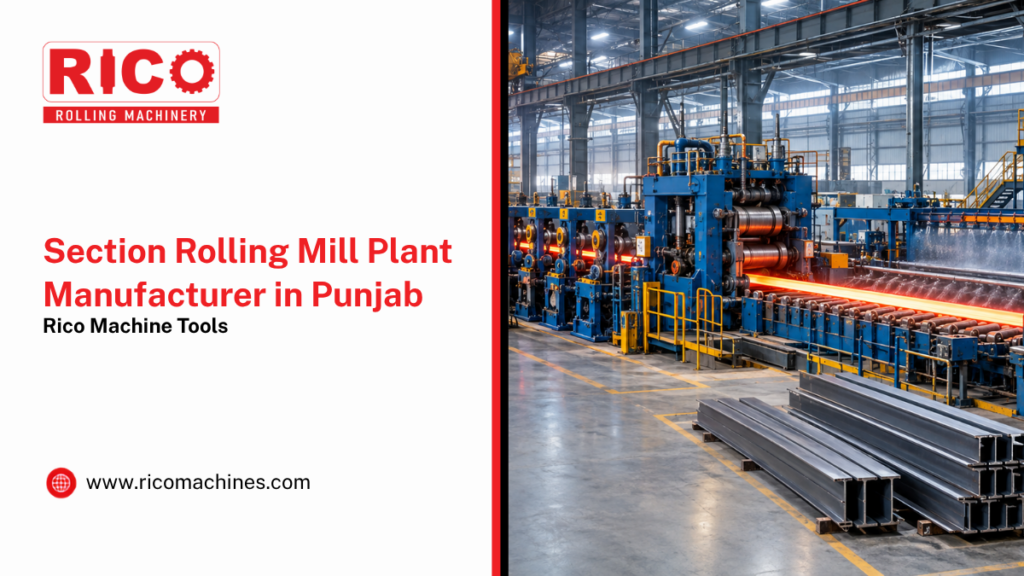
The demand for high-quality structural steel products is continuously increasing across construction, infrastructure, engineering, fabrication, and industrial applications. To meet this growing demand, modern steel manufacturers require reliable rolling mill plants that can deliver consistent production, dimensional accuracy, operational efficiency, and long-term performance. A properly designed section rolling mill plays an important role in converting heated steel billets into finished structural sections such as angles, channels, flats, beams, and other special shapes.
Rico Machine Tools is an experienced Section Rolling Mill Plant Manufacturer in Punjab, providing complete solutions for section steel rolling applications. Based in Mandi Gobindgarh, Punjab, the company specializes in designing and manufacturing rolling mill plants and allied machinery for long steel products. Its section rolling mill solutions are developed for light, medium, and heavy sections, as well as rails and special shapes.
What Is a Section Rolling Mill Plant?
A section rolling mill plant is an integrated steel processing system designed to produce structural steel sections from heated billets or other suitable raw materials. During the rolling process, steel passes through a series of rolling stands where its cross-sectional shape and dimensions are progressively changed according to the required finished product.
Section rolling mills are commonly used for producing products such as:
- Flats
- Angles
- C-Channels
- H-Beams
- I-Beams
- Structural sections
- Rails
- Special steel profiles
The selection of equipment, rolling configuration, production capacity, automation level, and finishing systems depends on the required product range and production objectives.
According to the product information provided by Rico Machine Tools, its section rolling mill plants can be supplied as fully automatic, semi-automatic, or manual production units. The company provides solutions for different section sizes and production requirements.
Why Choose a Section Rolling Mill Plant?
A well-engineered section rolling mill can improve production efficiency while maintaining the quality and dimensional consistency of finished steel products. Unlike basic rolling arrangements, a complete section mill integrates multiple stages of processing into a coordinated production line.
The major benefits include:
1. Consistent Product Dimensions
Structural steel products need accurate dimensions to meet application requirements. Properly configured rolling stands and finishing equipment help manufacturers maintain consistent product sizes and profiles throughout production.
2. High Production Efficiency
Modern section rolling mills can be configured for continuous and automated production. Automation can reduce unnecessary manual intervention, improve material handling, and support consistent production rates.
3. Multiple Product Profiles
A versatile section rolling mill can be designed to manufacture different structural profiles. Depending on the mill configuration, manufacturers can produce flats, angles, channels, beams, rails, and special shapes.
4. Improved Material Handling
Material handling equipment such as cooling beds, conveyors, stackers, and tying systems can streamline the movement of steel through different stages of production.
5. Long-Term Operation
Heavy-duty construction and appropriate equipment selection are important for steel plants operating under demanding conditions. Proper engineering and maintenance can help improve equipment life and minimize unnecessary downtime.
Section Rolling Mill Plant Configuration
A section rolling mill consists of several interconnected systems that work together to transform heated steel into finished structural products. The exact configuration can vary depending on the product range, billet dimensions, production capacity, and required automation.
A typical section rolling mill configuration may include:
Reheating Furnace
The reheating furnace heats steel billets to the required rolling temperature before they enter the rolling line. Uniform heating is important because it supports stable rolling conditions and helps achieve the desired material properties and dimensional quality.
Break Down Mill
The breakdown mill performs the initial reduction and shaping of the heated billet. Rico Machine Tools lists breakdown mill configurations of up to 5 MW for its section rolling mill solutions.
Continuous Rolling Train
The continuous rolling train progressively reduces and shapes the material through multiple rolling stands. Rico Machine Tools describes configurations using universal UNI-H stands along with three edgers, with cartridge-type arrangements.
Cooling Bed
After rolling, the hot finished sections need controlled cooling before subsequent finishing operations. A walking-beam type cooling bed can be incorporated into the section rolling mill line for efficient handling and cooling of rolled products.
Straightening Machine
Straightening equipment helps correct distortions or deviations after rolling and cooling. Depending on the plant design, straightening systems can use cantilever or double-supported configurations.
Cutting Equipment
Band saws can be used for cutting finished sections into required lengths. Accurate cutting is essential for preparing products for storage, transportation, and further fabrication.
Automatic Stacker and Tying Stations
For automated production lines, stackers and tying stations help organize finished products. These systems can reduce manual handling and improve overall plant productivity.
Weighing and Storage Area
The final stage may include weighing and storage arrangements where finished steel sections are organized before dispatch.
This integrated approach allows different stages of the rolling process to work together as a coordinated production system.
Products Manufactured by Section Rolling Mills
The type of products manufactured depends on the mill configuration and rolling requirements. A section rolling mill can be designed to produce various structural steel profiles used in construction and engineering.
Flats
Flat steel sections are widely used in fabrication, structural work, machinery manufacturing, and general engineering applications.
Angles
Steel angles are commonly used in structural frameworks, towers, fabrication, supports, and industrial structures. They can be produced in different dimensions according to customer and application requirements.
C-Channels
C-channel sections are frequently used in structural frames, supports, industrial structures, and fabrication projects.
H-Beams
H-beams are designed for applications where high structural strength and load-bearing capability are required. They are commonly associated with construction and infrastructure projects.
I-Beams
I-beams are important structural products used in buildings, bridges, industrial facilities, and other load-bearing applications.
Rails and Special Shapes
Specialized section rolling mills can also be engineered for rails and other customized steel shapes. The appropriate rolling configuration depends on the dimensions and geometry of the required finished product.
Production Capacity and Specifications
Rico Machine Tools provides section rolling mill solutions for different production requirements. The specifications published on its website include finished product ranges from light to heavy sections, with production capacities listed from approximately 60,000 tonnes per annum to 500,000+ tonnes per annum. The listed diameter range is 6 mm to 40 mm, with low and medium carbon steel identified as material grades.
The company also states that section rolling mills can be supplied in three production formats:
- Fully Automatic
- Semi Automatic
- Manual
This flexibility allows steel producers to select a plant configuration based on their production volume, investment plans, manpower availability, and automation requirements.
Importance of Automation in Section Rolling Mills
Automation has become increasingly important in modern steel production. Automated systems can coordinate different operations and help reduce manual intervention in repetitive production activities.
In a section rolling mill, automation can support:
- Material movement
- Rolling operations
- Cooling bed handling
- Product straightening
- Cutting
- Stacking
- Tying
- Weighing
- Production monitoring
A properly integrated automated production line can improve operational consistency while helping plant operators manage large production volumes.
However, the right automation level depends on the requirements of the steel plant. For some manufacturers, a semi-automatic system may provide the right balance between investment and productivity, while larger operations may benefit from a fully automated solution.
Why Rico Machine Tools?
Choosing the right manufacturer is one of the most important decisions when establishing or upgrading a section rolling mill plant. The supplier needs to understand not only individual machines but also the interaction between different systems across the complete production line.
Rico Machine Tools has developed solutions for hot rolling mills and long steel products, with its section rolling mill offering focused on light, medium, and heavy sections, rails, and special shapes. The company states that it has completed more than 100 projects involving the design, manufacturing, and installation of hot rolling mills for steel long products.
The company’s product portfolio also includes rolling mill stands, housingless mill stands, gears and gearboxes, TMT equipment, rolling mill parts, shearing and cutting machines, material handling equipment, and other allied machinery.
Having access to related rolling mill equipment from the same manufacturer can simplify equipment integration and support the development of a more coordinated plant solution.
Quality and Maintenance Considerations
The performance of a section rolling mill depends on more than the rolling stands alone. Proper maintenance, alignment, lubrication, inspection, and timely replacement of wear components are essential for maintaining reliable production.
Important maintenance areas include:
- Rolling mill stands
- Bearings and bearing chocks
- Gearboxes
- Couplings
- Guides
- Rollers
- Cooling systems
- Conveyors
- Shearing equipment
- Straightening equipment
Regular inspection can help identify potential problems before they lead to major production interruptions. Preventive maintenance is particularly important in heavy industrial environments where rolling equipment operates under high loads and temperatures.
Rico Machine Tools lists easy maintenance, safety features, durable construction, and long operating capability among the features of its section rolling mill solutions.
Applications of Section Rolling Mill Plants
Section rolling mills are used in industries where structural and long steel products are required. Finished products manufactured through these plants can serve applications across:
- Building construction
- Infrastructure development
- Industrial fabrication
- Engineering industries
- Structural steel manufacturing
- Bridges and infrastructure
- Heavy fabrication
- Machinery manufacturing
- Industrial frameworks
- General steel processing
As construction and infrastructure projects continue to require reliable structural steel products, efficient section rolling technology remains an important part of the steel manufacturing industry.
Choosing the Right Section Rolling Mill Manufacturer
Before investing in a section rolling mill plant, manufacturers should carefully evaluate their production requirements. Some of the key considerations include:
- Required product range – Determine whether the plant will manufacture angles, channels, beams, flats, rails, or special sections.
- Production capacity – Select equipment according to the desired annual production volume.
- Automation level – Decide between manual, semi-automatic, and fully automatic operation.
- Raw material specifications – Consider billet size, steel grade, heating requirements, and rolling temperature.
- Finishing requirements – Cooling, straightening, cutting, stacking, tying, and storage systems should be considered during plant planning.
- Maintenance support – Reliable technical support and availability of spare parts can help reduce long-term downtime.
- Plant integration – All major systems should be designed to operate together efficiently.
Rico Machine Tools – Your Section Rolling Mill Partner in Punjab
For steel manufacturers looking for a reliable Section Rolling Mill Plant Manufacturer in Punjab, Rico Machine Tools offers complete section rolling mill solutions designed around different production requirements.
The company’s section rolling mill plants are developed for light, medium, and heavy sections, rails, and special shapes. With configurations ranging from manual to fully automatic production systems and capacities extending from 60,000 TPA to 500,000+ TPA as listed on its website, the solutions can be planned for a wide range of steel production requirements.
Located in Mandi Gobindgarh, Punjab, a major industrial centre associated with India’s steel and rerolling industry, Rico Machine Tools provides rolling mill machinery and allied equipment for steel manufacturers.
Conclusion
A section rolling mill plant is a major investment for steel manufacturers seeking to produce high-quality structural sections efficiently. From reheating and breakdown rolling to continuous rolling, cooling, straightening, cutting, stacking, and storage, every stage must work together for reliable production.
Selecting an experienced Section Rolling Mill Plant Manufacturer in Punjab can help steel producers develop a plant that matches their required product range, production capacity, automation level, and operational objectives.
Rico Machine Tools provides section rolling mill solutions for light, medium, and heavy sections, along with rails and special shapes. With a broad range of allied rolling mill machinery and experience in designing and manufacturing steel rolling solutions, Rico Machine Tools can support manufacturers looking for dependable equipment for modern long-product steel production.
For businesses planning a new section rolling mill or upgrading an existing production line, selecting the right equipment configuration and manufacturing partner is an important step toward achieving efficient, consistent, and sustainable steel production.