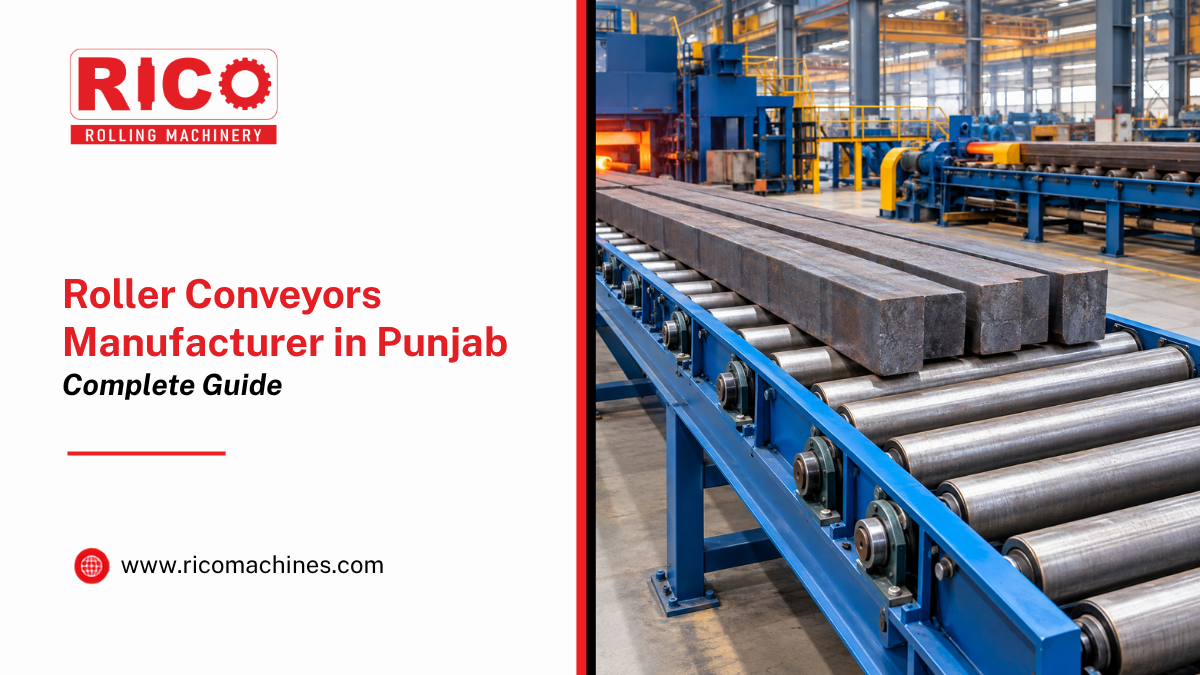
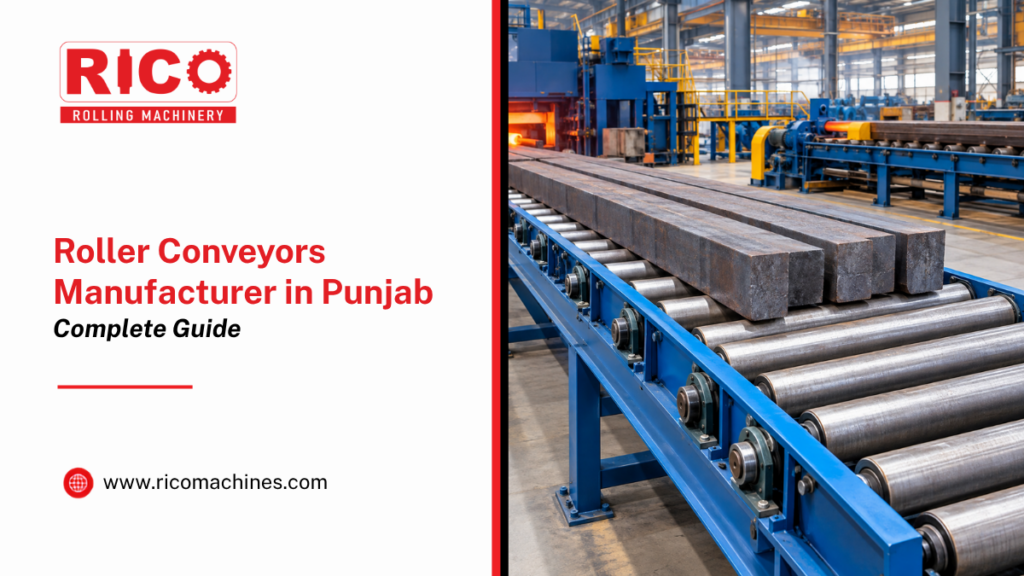
In modern steel plants and rolling mills, efficient material handling is essential for maintaining continuous production and reducing unnecessary manpower. Roller conveyors play an important role in transporting billets, slabs, sheets, angles, channels, flats, rounds, and other steel products safely and efficiently from one stage of production to another. As an experienced Roller Conveyors Manufacturer in Punjab, Rico Machine Tools provides reliable conveyor systems designed for demanding rolling mill and steel plant applications.
Based in Mandi Gobindgarh, Punjab, the company manufactures and supplies rolling mill machinery, material handling equipment, TMT equipment, rolling mill components, shearing machines, gears, gearboxes, and other allied machinery. Its roller conveyor solutions are available in standard as well as customized sizes to suit different production requirements.
What Are Roller Conveyors?
Roller conveyors are mechanical material handling systems consisting of a series of rollers mounted within a supporting frame. The rollers allow heavy materials to move smoothly from one location to another with controlled movement and positioning.
In steel and rolling mill applications, roller conveyors are commonly used for transporting hot and cold steel products such as billets, bars, angles, channels, flats, rounds, slabs, sheets, pipes, and fabricated steel components.
Unlike manual material handling, conveyor systems can provide a continuous and organized flow of material throughout the production line. This helps improve productivity while reducing the need for excessive manpower.
These conveyors are manufactured specifically for industrial environments where strength, durability, controlled movement, and reliable operation are important.
Roller Conveyors for Rolling Mills
Rolling mills require efficient movement of steel products between different processing stages. After rolling, steel products may need to be transferred toward cooling beds, cutting machines, straightening equipment, inspection areas, storage sections, or other production stages.
A properly designed roller conveyor helps maintain this continuous material flow.
In hot rolling applications, the transported material can remain at extremely high temperatures. Therefore, conveyor construction and components must be selected according to the operating conditions and material being handled.
Roller conveyor systems can be designed for rolling mill applications involving products such as:
- Steel angles
- Channels
- Flat bars
- Round bars
- Billets
- Slabs
- Steel sheets
- Pipes and tubes
- Fabricated steel components
- Other rolled steel products
The conveyor design can be determined according to factors such as load, conveying surface, motor power, support structure, and application requirements.
Why Roller Conveyors Are Important in Steel Plants
Material movement is one of the critical parts of a steel production line. Delays in transporting material can affect production efficiency and create bottlenecks between different machines.
Roller conveyors provide a controlled method of transferring material while helping maintain the required production flow.
Some important advantages include:
1. Continuous Material Movement
Roller conveyors allow steel products to move continuously between different stages of production. This is particularly useful in rolling mills where maintaining a consistent production flow is important.
2. Reduced Manual Handling
Heavy steel products can be difficult and time-consuming to move manually. Conveyor systems reduce dependence on manual handling and help improve workplace efficiency.
3. Improved Production Capacity
An efficient conveyor arrangement can help increase the overall productivity of a rolling mill by reducing unnecessary movement and waiting time.
4. Controlled Material Positioning
Roller conveyors can help guide and position products as they move through different sections of a production line. Controlled movement is particularly important before cutting, cooling, inspection, or further processing.
5. Suitable for Heavy Loads
Industrial roller conveyors can be designed to handle substantial loads. Their capacity depends on factors such as roller construction, support structure, drive system, motor power, and the characteristics of the material being conveyed.
Types of Roller Conveyors
As a Roller Conveyors Manufacturer in India, the company offers different conveyor and roller table configurations according to application requirements.
Chain Driven Conveyors
Chain-driven roller conveyors use a chain-based drive arrangement to transfer power to the rollers. They are suitable for applications where controlled movement of heavy steel products is required.
The robust drive arrangement makes this type of conveyor suitable for demanding industrial environments and rolling mill applications.
Pulley Driven Conveyors
Pulley or V-belt-driven conveyor systems use a pulley and belt arrangement for transmitting movement to the rollers. These systems can be selected according to the required conveying speed, load, and production arrangement.
Gravity Conveyors
Gravity conveyors use the natural force of gravity to move suitable materials along the conveyor. They can be useful in applications where powered movement is not necessary or where the production layout permits gravity-based transportation.
Transfer Tables
Transfer tables are used when material needs to be moved from one conveyor line or position to another. They can form an important part of integrated material handling systems in steel plants.
Run Out Tables
Run out tables provide a controlled area for receiving and moving rolled products after a particular processing stage. They can help maintain an organized flow of material throughout the production line.
Turn Around Tables
Turn around tables are designed for applications where the direction or orientation of the material needs to be changed as part of the production process.
These different conveyor configurations allow manufacturers to select a suitable material handling arrangement according to their plant layout and production requirements.
Key Features of Industrial Roller Conveyors
The performance of an industrial conveyor depends greatly on the quality of its construction and drive components. Properly engineered systems can incorporate several features for reliable industrial operation.
Important features include:
- Chain-driven options
- V-belt and pulley-driven options
- Quality bearings
- Seamless pipes with tested shafts
- Strong supporting structures
- Side frames for improved safety
- Standard and customized conveyor sizes
- Designs suitable for rolling mill applications
These features help the conveyor system withstand demanding operating conditions while providing controlled movement of industrial materials.
Customized Roller Conveyors for Industrial Applications
Every steel plant does not have the same production capacity, layout, material dimensions, or handling requirements. For this reason, a standard conveyor may not always be the most suitable option.
Custom-size roller conveyors can be manufactured according to the requirements of individual applications. Conveyor dimensions, drive arrangements, supporting structures, roller configuration, and other design considerations can be selected according to the customer’s production requirements.
Customization can be particularly useful when integrating conveyors with existing rolling mill equipment.
For example, a conveyor may need to connect with a rolling mill stand, cooling bed, shearing machine, inspection area, or another material handling system. Proper integration helps create a smoother production flow and minimizes unnecessary material movement.
Applications of Roller Conveyors
Roller conveyors are widely used across steel manufacturing and other heavy industrial applications.
Typical applications include:
Steel Rolling Mills
Roller conveyors are used for transferring rolled steel products between different stages of the rolling process.
Hot Rolling Plants
Hot steel products require controlled and continuous transportation. Roller conveyors can help transfer material while it remains at elevated temperatures.
Billet Handling
Billets can be transported between reheating, rolling, cutting, and other processing stages using suitable conveyor arrangements.
Steel Sheet Handling
Roller conveyor systems can be used to transport sheets and plates between processing and handling areas.
Bar and Section Handling
Angles, channels, flat bars, round bars, and other sections can be moved through the production line using appropriate roller table configurations.
Fabricated Steel Products
Roller conveyors can also be used for moving fabricated steel components and other heavy industrial products.
The actual conveyor configuration depends on material dimensions, weight, temperature, production speed, and plant layout.
Importance of Proper Conveyor Selection
Choosing the right roller conveyor is important for achieving reliable material handling performance. Several factors should be evaluated before selecting or designing a conveyor system.
Material Weight
The conveyor must be designed according to the weight of the products being transported. Heavy steel products require appropriate rollers, shafts, bearings, frames, and support structures.
Material Dimensions
The width, length, and shape of the material influence roller spacing and conveyor dimensions.
Operating Temperature
Hot rolling applications require components and construction materials suitable for elevated temperatures.
Conveying Speed
The required production speed determines the appropriate drive arrangement and motor selection.
Plant Layout
The conveyor should fit efficiently within the existing plant layout and connect correctly with other machinery.
Production Capacity
The expected production volume should be considered when selecting conveyor dimensions and drive systems.
A properly selected conveyor can contribute to smooth production and reduce operational interruptions.
Roller Conveyors Manufacturer in India
Rico Machine Tools is an established manufacturer and exporter of machinery and equipment for rolling mills and steel plants. Its product range includes rolling mill plants, rolling mill stands, housingless mill stands, gears and gearboxes, TMT equipment, rolling mill parts, shearing and cutting machines, material handling equipment, and other allied machinery.
As a Roller Conveyors Manufacturer in India, the company focuses on providing practical conveyor solutions for demanding industrial applications. Its experience in rolling mill machinery allows conveyor systems to be designed with consideration for the wider production process rather than as an isolated piece of equipment.
The roller conveyors are manufactured for handling different steel products and can be supplied in standard or customized sizes depending on application requirements.
Why Choose an Experienced Roller Conveyor Manufacturer?
Selecting an experienced manufacturer is important when purchasing equipment for a steel plant or rolling mill. Customers looking for industrial roller conveyor solutions can consider the following advantages:
Experience in Rolling Mill Machinery
A broad range of equipment used in rolling mills and steel production facilities provides a strong understanding of material handling requirements.
Customized Solutions
Roller conveyors can be manufactured in standard and custom sizes to accommodate different production requirements and plant layouts.
Industrial Construction
The conveyors are designed with components such as quality bearings, tested shafts, seamless pipes, drive systems, and supporting frames for industrial applications.
Complete Material Handling Range
Along with roller conveyors, the product range includes other material handling equipment, including Y tables, furnace pushers, coilers, decoilers, and vertical loopers.
Integrated Rolling Mill Solutions
Because the manufacturer also supplies rolling mill stands, shearing machines, TMT equipment, gearboxes, and other machinery, customers can source multiple types of rolling mill equipment from one manufacturer.
Conclusion
Efficient material handling is essential for maintaining productivity and smooth operation in steel plants and rolling mills. Roller conveyors provide a practical solution for transporting heavy steel products such as billets, angles, channels, flats, rounds, slabs, and sheets between different stages of production.
As a reliable Roller Conveyors Manufacturer in Punjab, Rico Machine Tools manufactures standard and customized conveyor systems designed for demanding industrial applications. Its range includes chain-driven conveyors, pulley-driven conveyors, gravity conveyors, transfer tables, run out tables, and turn around tables.
With experience in rolling mill machinery and material handling equipment, conveyor solutions can be developed around specific production requirements, material characteristics, and plant layouts.
For companies looking for a dependable Roller Conveyors Manufacturer in India, these industrial conveyor systems can support efficient material movement, reduced manual handling, and improved production flow.